
Here’s something most beginners don’t realize: your hook is probably the most important piece of tackle in your box. You can have the best rod, reel, and line money can buy — but if your hook is the wrong size for the fish you’re after, you’ll come home empty-handed. The good news is that understanding hooks is much simpler than it looks once you know the basics.
Think of choosing a hook like choosing a plate size for dinner. A big steak needs a big plate; a slice of pie goes on a small one. Fish hooks work the same way — match the hook to the fish’s mouth and your bait, and everything else falls into place naturally.
How Hook Sizes Work
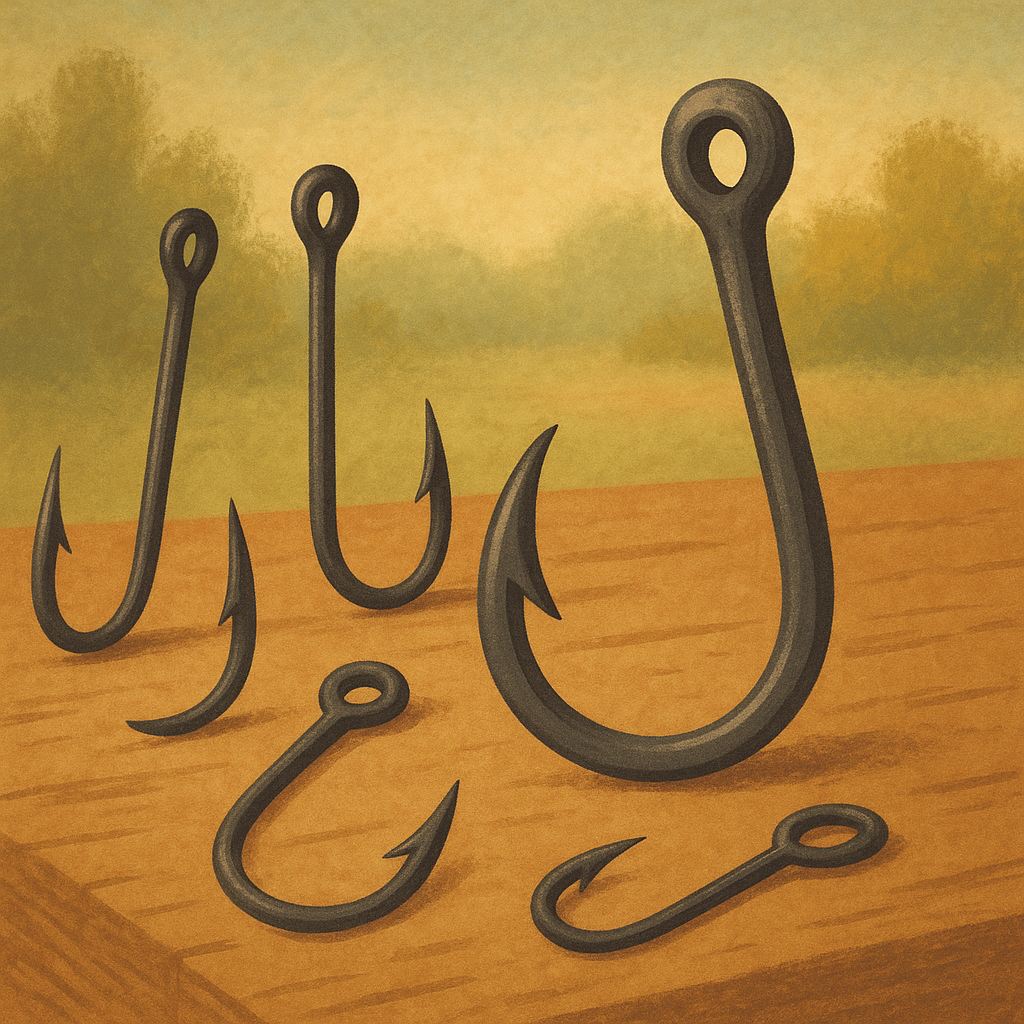
The hook sizing system trips up a lot of beginners because it seems backwards at first. For smaller hooks, the numbering works like this: the bigger the number, the smaller the hook. So a size 10 hook is smaller than a size 6 hook. Confusing, right?
Once hooks get large enough, the system switches to the “aught” scale — written as 1/0, 2/0, 3/0, and so on. Here it works the opposite way: a 3/0 is bigger than a 1/0. As a simple mental model, think of the regular numbers (6, 8, 10) as small hooks for small fish, and the aught numbers (1/0, 2/0, 3/0) as big hooks for big fish.
- Panfish (bluegill, crappie): Size 8–12 hooks work perfectly
- Bass and perch: Size 4–8 covers most situations
- Catfish and walleye: 1/0 to 3/0 for live bait setups
- Pike and large catfish: 4/0 to 6/0 for big presentations
The Most Useful Hook Types for Freshwater Beginners
There are dozens of hook styles out there, but you only need to know about four to get started. Each one is designed for slightly different situations, and knowing when to use which one can make a real difference.
J-Hooks: The Classic All-Rounder
J-hooks are shaped exactly like the letter J, and they’re the most common hook in freshwater fishing. They work with live bait, cut bait, and most soft plastics. The catch? You need to actively “set” the hook when you feel a bite — that means giving your rod a firm upward snap to drive the point into the fish’s mouth. J-hooks are a great teaching tool because they make you pay attention to what you’re feeling through the line.
Circle Hooks: The Beginner-Friendly Option
Circle hooks have a distinctive inward-curved tip that looks almost like it points back toward the shank. They’re designed to set themselves — when a fish picks up the bait and swims away, the hook naturally rotates into the corner of the fish’s mouth without you having to do anything dramatic. Instead of a sharp hookset, you just reel in steadily. Circle hooks also dramatically reduce the chance of a fish swallowing your hook, making them ideal for catch-and-release.
Bait Holder Hooks: Keeping Live Bait On
Bait holder hooks look like J-hooks but have small barbs along the shank — those extra rough spots grip worms and soft baits so they don’t slide off after your cast. If you’re fishing with nightcrawlers or worm pieces, bait holder hooks make your life much easier.
Aberdeen Hooks: Best for Live Minnows
Aberdeen hooks have a round bend and wide gap that lets small minnows and other live baitfish swim naturally without restricting their movement. The thin wire is also easy to bend free if you get snagged on the bottom — a real plus when you’re fishing around rocks or woody debris.
Pros and Cons of Circle vs. J-Hooks
Self-setting design
Fish set the hook themselves when they swim away — you just reel. Great for beginners who aren’t sure when to strike.
Excellent for catch-and-release
Hooks almost always end up in the corner of the mouth, making removal easy and minimizing fish injury.
Fewer missed strikes
You don’t need precise timing — steady pressure does the work for you.
Requires active hookset
You need to feel the bite and react quickly with a firm snap — beginners sometimes strike too late or too early.
Higher gut-hook risk
If a fish swallows the bait before you strike, the hook can end up deep inside — harder to remove and more stressful for the fish.
Hook Anatomy: What the Parts Mean
You’ll see these terms on packaging and in fishing conversations, so it helps to know them:
- Point: The sharp tip that penetrates the fish’s mouth. Look for a sharp, clean point — dull hooks lose fish.
- Barb: The small backward projection just behind the point that keeps the fish from shaking the hook loose. Barbless hooks (or pinched barbs) make release easier.
- Gap: The space between the hook point and the shank. Wider gap = better for bulky baits and larger fish mouths.
- Shank: The long straight section where you thread your bait. Longer shanks make bait removal and threading easier.
- Eye: Where you tie your line. Straight, upturned, or downturned — each affects hook angle and bait presentation slightly.
Frequently Asked Questions
How do I know if my hook is the right size?
A simple rule: the hook gap (the opening) should be roughly the same width as the fish’s mouth you’re targeting. For panfish, a narrow gap works fine. For bass, you want a wide gap that clears the worm or bait. When in doubt, go one size smaller rather than larger — a smaller hook hooks more fish than an oversized one.
Should I use barbless hooks?
Some waters require barbless hooks by regulation — always check local rules. Even where not required, many anglers pinch the barb down with pliers for easier catch-and-release. A barbless hook in a fish’s mouth for 30 seconds does much less damage than spending two minutes digging out a barbed hook. You do lose slightly more fish with barbless, but maintaining steady rod pressure reduces that difference.
Do hook brands matter?
More than you might think. Premium brands like Gamakatsu, Owner, and Mustad produce sharper, stronger hooks that come with the point already honed. Budget hooks from the dollar bins are often dull out of the package. A pack of quality size 6 hooks costs $3–$5 and is worth every penny compared to losing fish on inferior hardware.
How many hooks should I have in my tackle box?
A good starter assortment covers sizes 12, 8, and 4 in J-hooks, sizes 6 and 2 in circle hooks, and a few 1/0 circle hooks for catfish or larger bass. That’s five different hooks and covers probably 90% of freshwater situations you’ll encounter. Keep a few extras of each — hooks are cheap insurance.
Final Thoughts
Hooks are inexpensive, easy to carry, and make a bigger difference than most beginners expect. Keep a small assortment in your tackle box — a handful of size 8 and 12 J-hooks for panfish, size 4–6 circle hooks for bass and general use, and a few 1/0 circles for catfish. Replace any hook that looks rusty, bent, or dull. A sharp, properly-sized hook is the simplest upgrade you can make to catch more fish starting on your very next trip.