
If the rod is your arm, the reel is your hand. It’s the mechanism that controls your line — casting it out, fighting the fish, and retrieving your bait. Choose the wrong type of reel and you’ll be spending more time untangling line than actually fishing. Choose the right one and you’ll be casting smooth from your very first trip.
Good news: for most beginners fishing freshwater in ponds, lakes, and rivers, the choice comes down to just two options. Let’s break it all down so you can buy with confidence.
The Three Main Types of Fishing Reels
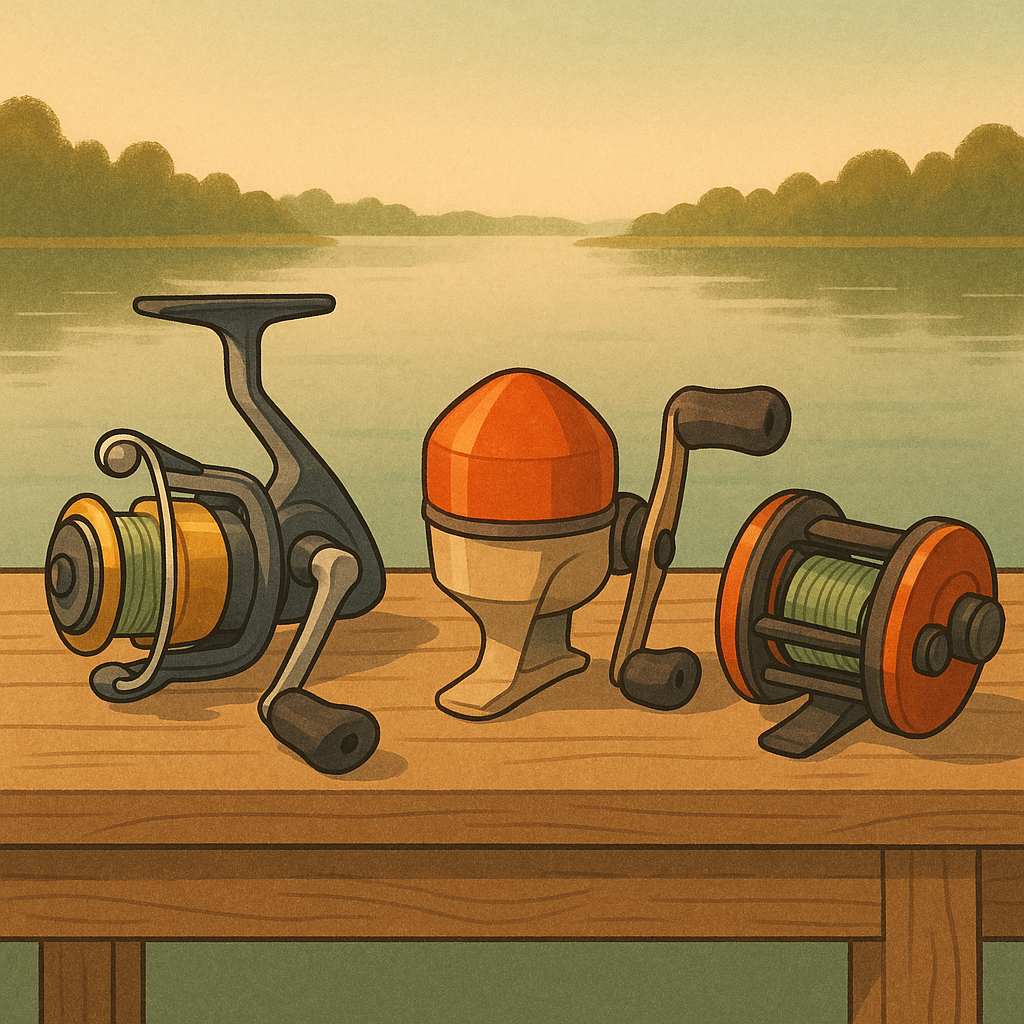
Walk into any fishing department and you’ll see three main reel categories. Understanding what makes each type different will instantly clarify which one belongs in your hands.
Spinning Reels (Open Face)
The spinning reel is the most popular choice for freshwater beginners — and for good reason. It mounts under the rod, uses an open face design, and casts by simply opening the bail (a wire arm) and releasing line. Spinning reels are forgiving, versatile, and work with lighter lures and lines better than other types. They’re not perfect — they can twist line over time — but for beginners, they’re the clear winner.
Spincast Reels (Closed Face)
Spincast reels are the simplest of all. The line is enclosed in a cone-shaped housing, and casting is as easy as pushing a button and releasing your thumb. You’ve probably seen these — Zebco is the most famous brand. They’re excellent for kids and absolute beginners, but they have less line capacity and fewer drag settings than spinning reels. Great starting point, but most anglers “graduate” to spinning reels within a season or two.
Baitcasting Reels
Baitcasting reels sit on top of the rod and require thumb pressure during the cast to control line speed. When done right, they’re incredibly accurate and powerful — preferred by experienced bass anglers. When done wrong (and beginners almost always do it wrong at first), they backlash — the spool spins faster than the line goes out, creating a bird’s nest tangle. Not recommended for beginners.
Understanding Spinning Reel Specs
Once you’ve decided on a spinning reel, you need to understand what the numbers and specs mean. Here’s what actually matters for a beginner:
Reel Size
Spinning reels are sized by number — 1000, 2000, 2500, 3000, 4000, etc. The number roughly corresponds to line capacity and physical size. For most freshwater fishing (bass, panfish, catfish up to 10 lbs), a 2000 to 3000 size reel is the sweet spot. It holds enough line, isn’t too heavy for a day of fishing, and pairs well with a 7′ medium-power rod.
Gear Ratio
The gear ratio tells you how many times the rotor spins per handle turn. A 6:1 ratio means the rotor turns 6 times for every turn of the handle. For beginners, a ratio of 5:1 to 6:1 is ideal — it retrieves line at a useful pace without being too fast or too slow for general fishing.
Drag System
The drag is what prevents the line from snapping when a fish pulls hard. It works like a brake — letting the fish take line slowly rather than breaking free. Most spinning reels have either a front drag (smoother, more powerful, preferred by most anglers) or a rear drag (easier to adjust on the fly). For beginners, front drag is generally better quality. Set it before fishing so the line gives with steady resistance but doesn’t slip too easily.
Ball Bearings
More bearings generally means a smoother reel, but quality matters more than quantity. A reel with 3 high-quality bearings will feel smoother than one with 7 cheap bearings. As a beginner, look for at least 3-4 bearings in a mid-range reel ($30-60).
- Spool the reel correctly: Load line in the same direction the reel’s spool rotates — this minimizes line twist, which causes casting problems.
- Set the drag before each trip: Pull line by hand — it should give steadily with moderate pressure. Tight enough to set hooks, loose enough to let a fish run without breaking.
- Rinse after use: Even in freshwater, a quick rinse and dry extends reel life significantly.
- Store loosened: Back off the drag knob slightly when storing. Keeping it cranked tight compresses the drag washers and reduces their life.
Pros and Cons of Spinning Reels
Easy to learn and use
Open the bail, cast, close the bail — the casting motion is natural and consistent, with minimal backlash risk for new anglers.
Works with light lures and lines
Spinning reels handle 6-12 lb monofilament and lighter lures better than baitcasters, making them ideal for panfish, trout, and bass.
Wide price range
Quality spinning reels are available from $25 (Zebco Omega) to $300+ (Shimano Stradic). Beginners can get excellent performance in the $30-60 range.
Line twist over time
Spinning reels can introduce twist into the line, especially if you reel against the drag (fighting a fish while cranking). Use a swivel and respoo occasionally to manage this.
Less precise casting than baitcasters
For pinpoint accuracy at specific targets (like flipping to a dock piling), baitcasting setups are more precise. Spinning reels cast in a wider arc.
Frequently Asked Questions
What size spinning reel should I get for bass fishing?
A 2500 or 3000 size reel paired with a 7′ medium-power rod is the classic bass fishing beginner setup. It handles 10-12 lb monofilament comfortably and fights bass up to 5-6 lbs without strain on the reel.
How long should a fishing reel last?
A quality spinning reel in the $40-80 range, properly maintained (rinsed, stored loosened), can last 5-10 years. Budget reels under $20 often wear out within a season or two. Mid-range reels from Shimano, Daiwa, or Penn offer the best value-to-longevity ratio for beginners.
Can I use a spinning reel for catfish?
Yes. A 3000 or 4000 size spinning reel loaded with 12-17 lb monofilament works fine for channel catfish up to 10-15 lbs. For larger blue catfish or flatheads, you’ll want a heavier setup — but for beginners targeting average channel cats, a mid-size spinning reel is perfectly adequate.
What’s the best budget spinning reel under $50?
The Shimano Sedona FJ ($45-55) and the Daiwa Revros LT ($35-45) consistently earn high marks for smoothness and durability in the budget range. Both feel significantly better than their price suggests and will last several seasons with proper care.
Final Thoughts
Picking your first fishing reel comes down to one simple decision: spinning reel for most situations, spincast if you absolutely want the easiest possible start. Don’t overthink gear ratios and bearing counts when you’re brand new — those details matter more once you’ve developed a feel for fishing.
Buy a decent spinning reel in the 2500-3000 size from a reputable brand, learn to set the drag properly, and go catch some fish. The reel will teach you more in a single afternoon on the water than any spec sheet ever could. That’s how it works with fishing — experience is always the best teacher.